Meditation and the Repressed Unconscious
This essay includes descriptions of child abuse. Read with care.
The Sparing of Blows
Case 15 of the Mumonkan, a major collection of koans (stories and challenges) worked on in Zen meditation, goes:
Tozan came to see Ummon, and was asked by him, “Where have you come from?” “From Sado,” he replied. “Where were you during the summer retreat?” “I was at Hozu Temple in Konan Province,” replied Tozan. “When did you leave there?” “On the twenty-fifth of August.” Ummon burst out, “I spare you sixty blows!”
The next day Tozan came again before Ummon, and said, “Yesterday you said I should receive sixty blows. I don’t know where my fault was.” Ummon said, “You rice bag! Why do you wander about, now west of the river, now south of the lake?” At this Tozan was enlightened.
Koans are challenging. They ask the practitioner to enter into the story and crack open the jewel of non-dual truth hidden therein. It’s mind-bending, beautiful work. This particular koan, though, challenged me in a different way, one I could not make sense of. I went to my teacher with the intention of demonstrating, with my entire body-mind, the deepest meaning of this story. Instead, in dokusan (a meeting with my teacher), I was totally frozen. I sat, locked in a totally flat and affectless state of disconnection that I could neither shake nor penetrate. The blankness I felt was not the dynamic, spontaneous, radically empty mind borne of deep practice, but something hollow and dead. My teacher appeared curious and full of care. He encouraged me to remain open to anything that arose, both in and out of meditation, and to trust the natural, mysterious currents of my own unfolding self, whatever form these energies might take. I left our meeting a bit bewildered and frustrated with myself.
A few days later, I stopped at a coffee shop while out running errands alone. I was in an unusually buoyant and social mood, and I enjoyed talking with the baristas. While making my coffee, one of them said to the other, “Did you know scientists have discovered that the color purple doesn’t exist?” And I, without a thought, responded with a laugh, “Don’t let them take purple away from you! Trust your own experience!” I could tell by their body language that both baristas were shocked, maybe a bit unsettled by my intensity. I had meant to be playful, but I had a feeling that I had done some kind of harm.
I went back to my car and was immediately immersed in terrible feelings. It was as if liquid shame filled the car, drowning me. I started speaking out loud, talking to myself about how I felt. I remembered my teacher’s words, to be open and curious about my experience and mustered a modicum of curiosity. I talked about how awful I felt that as soon as I let my guard down, I hurt people. The interchange with the baristas had activated a deeply held but often covert imperative: that I must pay immaculately close attention to myself, monitoring and controlling my behavior. This injunction is protective: there is a fear that if I lose this hold over myself, I will become a huge, idiotic monster. I will inflict untold destruction not through evil, but through ignorance and clumsiness. I struggled to find a perch outside the shame from which to view it; it felt strong, total, and real.
Then a memory rose into consciousness; I am around six years old. One of my caregivers is screaming at me and a younger family member. Screaming and crying with rage and disgust. They tell us to lie face down on the bed and they take off their belt, letting us know they intended to beat us. They rear back and slam the belt down, hard, on the bed between us. Thwack… thwack… thwack. The adult in the room is sobbing loudly. The belt never strikes me, but again and again it almost strikes me. I am spared, perhaps, sixty blows.
In the car, strong currents of fear buzz through me. I tremble and sweat; my body is the body of a terrified and humiliated child. Waves of anger begin to crash chaotically, mixing with the fear. The anger lets me begin to get my head above water, coming into my adult body-mind, here and now. I begin to see from this vantage point how undeniably wrong it is to terrify and humiliate a child. I see that this has nothing to do with me or my behavior, that I could do nothing worthy of this punishment. My rage crushes out the fear and boils hot—hateful, aggressive images join with a tremendous sense of relief and rightness, and this strong, unencumbered knowing courses through me with urgency. Slowly, the heat starts to release and dissipate. The rage deflates into a soft, painful grief. I cry hard for some minutes, knowing what was broken and lost in that moment, and in a dozen others. After some time, I see the younger child in my arms. The storm is over, and we are safe and okay now, together.
After sitting with a clear kind of relief for some time, I notice an empathy start to emerge. The rage isn’t gone, but it starts to widen and mix with care. This person who abused me is not a monster. In the outlines of this cruel moment, I can see the outlines of a deep conflict—not quite able to hit us, not quite able to stop. I can see that this person, whom I love, was surely beaten in their own childhood, and they must know its horror first hand. In the car, I feel a confusing, sad awe as I consider their experience, the mixture of compulsion and self-disgust they must have contended with. I sigh deeply, settling back into an adult self with adult thoughts and feelings, and I drive away.
This cascade rose and fell in 15 minutes—it left me feeling spent, but soft and open. In those 15 minutes was also 15 years of practice, both spiritual and psycho-emotional. At earlier times in my life, such a memory would most likely have remained unconscious, but its shadow would have driven a more immersive and credible experience of shame and self-hatred. Many times, my younger self, incapable of the distance needed for adequate reflection and curiosity, compulsively responded to moments of confused shame with some mixture of self-punishment, explosive behavior, and total shutdown. For many years, I was a real mess. My experience tells me, though, that we aren’t doomed to repeat our pain forever. Something else is possible, at least sometimes. But how? How do we understand and free ourselves from intergenerational and intrapsychic cycles of abuse? At times, a meditation practice seems to support this kind of healing. Other times, it appears irrelevant to one’s emotional struggles or even to exacerbate them. Ever the obedient Zen practitioner, I am compelled to ask: what’s going on here?
Families of Meditation
Meditation has multifaceted, reciprocal impacts on the psychological and emotional aspects of our lives. Different types of meditation will have different effects. Three families of meditation practices have been identified by researchers and theorists: attentional, constructive, and deconstructive. Attentional practices are those aimed at training the mind to stay anchored on a specific object. Mindfulness, body scans, dispassionate observation, and labeling practices are examples of attentional meditation. Constructive practices train a person to cultivate specific states or feelings and are often guided or follow a predetermined visualization process. This includes loving-kindness (metta), compassion, and gratitude focused meditations. The final family of meditation practices are deconstructive. Deconstructive meditation includes nondual practices which usually build upon a strong foundation of attentional practice. This category includes Zen koan work, self-inquiry, and the Tibetan practices of Dzogchen and Mahamudra. Deconstructive meditation aims to transcend, penetrate, see through, or break down inner structures and assumptions related to reality and the self.
While these categories are imperfect and overlapping, they are a useful frame. The type of practice we engage in will greatly influence how meditative and psycho-emotional experiences interact. The impacts of constructive practices are complex and highly variable. For some people some times, they have the simple, direct, and intended effect: self-compassion practices, for example, make one more self-compassionate. But, due to the complexity of the human mind, attempts to feel a certain way can easily go awry. The reasons for this will be explored shortly.
Attentional practices help practitioners orient toward their inner world, increasing awareness of thoughts, feelings, and body sensations. These practices also generate more and more interior space—attentional meditators learn to separate from, observe, and accept a wide range of experiences, including distressing ones. Attentional practices seem to create a more stable and reliable inner space, and reduce reactivity.
Deconstructive practices take this inner stability as a jumping off point for exploration. Once we can observe and accept our experience, we can start asking who or what, exactly, is doing this observing and accepting. These practices purposefully interrogate and overturn basic assumptions related to being, knowing, and experiencing. This kind of practice can be destabilizing and can mobilize or “stir up” layers of unconscious dynamics. In nondual meditation, we move from an awareness of our interior life into a dynamic, questioning engagement with it. This may lead to meditative and emotional experiences that are richer, more complex, and more challenging. In order to understand these processes, it may be useful to describe a model of psychodynamics: that is, a model of the psychology of the unconscious.
A Crash Course in Psychodynamics for Dharma Practitioners
As I introduce a map of one region of the human interior, I want to be clear that it fails to fully capture the experience it represents. I believe it is a good model, but models are always inherently inadequate. In the words of the philosopher Bayo Akomolafe:
The systemic is intelligible. Relationality exceeds intelligibility. It is the insensible, and it flows. So even, in a sense, the field of relationality exceeds the intelligible.We are being invited to stay with its flow whether it is rendered legible or not. We are being invited to hold space for the fact that not everything can be reduced to the algorithms of intellectual capture. We will not systematize everything. The world flows beyond that.
So, here, I humbly offer an “algorithm of intellectual capture” to support us in our efforts to go beyond the intellectual, to touch into the insensible flow of being. May this model be useful without being oppressive.
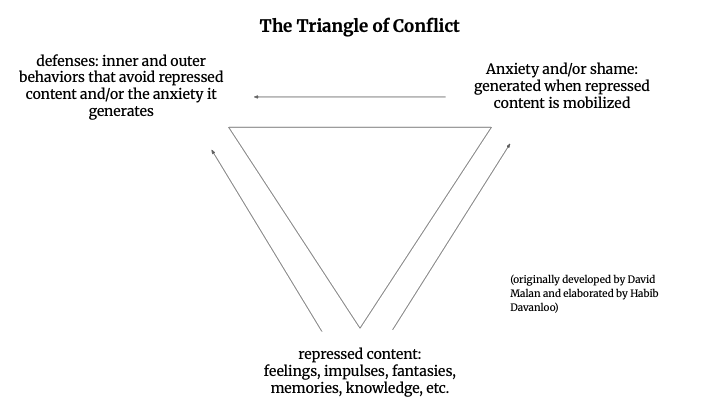
Let’s orient. The bottom of the triangle, repressed content, represents anything we push out of awareness because we believe, on some level, that it would be too painful, overwhelming, terrifying, or discordant to face directly and integrate into our sense of self. Repression happens automatically and outside of conscious awareness. When we purposefully push our feelings away this is called suppression, not repression. Both repression and suppression can be used in ways that are helpful to us, and also in ways that are destructive.
Repressed content doesn’t have to be totally forgotten, and it often isn’t. In the introduction to this essay, I described a memory that I was aware of, but my remembering was totally flat. Although I knew what happened, I was disconnected from its meanings, feelings, and impulses. While the memory was available cognitively, repression was still operating.
The repressed represents a tiny corner in the great, mysterious expanse of the unconscious. I believe that most of our knowledge, motivations, conditioning, and beliefs are unavailable to the conscious mind; this is a normal and healthy state of affairs. Repression occurs when that which would naturally flow in and out of consciousness is instead firmly and artificially kept out of awareness. Repression can be problematic in our lives and relationships, partly because it has major costs and partly because it just doesn’t work very well—the dam is cumbersome to upkeep, and it always leaks.
The moments of our lives constantly spark associations from the past, including dreams and fantasies. Thoughts, memories, feelings, and impulses flow in and out of the conscious mind in response to the flow of our experience. If something activated in this way has been repressed, a person can be caught between the force that pulls it toward awareness and the counter-force of repression which pushes it away. It is a bit like a bubble naturally rising toward the surface of a pool while one tries to keep it under water… if one were committed to remaining unaware of the bubble’s existence. It is universally uncomfortable.
This kind of pressurized discomfort is what I’m calling anxiety, which can include shame or other inhibitory reactions. This type of anxiety (there are, of course, others) can have many forms and layers. It can be conscious, unconscious, or can hover in the field between. At times, anxiety is experienced as muscle tension, stomach butterflies, or restlessness. Other times, it can be overwhelming and make one feel disconnected, nauseous, dizzy, and even make it hard to think clearly. When anxiety goes unresolved for a long time, it can contribute to chronic illness or pain.
In the story I told above, both the content of the koan and the experience in the coffee shop mobilized feelings related to my memory of being abused. In dokusan with my teacher, I had no conscious knowledge of what was stirring beneath the surface. Unconscious anxiety manifested as a flaccid blankness. At the coffee shop, I perceived a subtle rejection—there was a sense that I had made a mistake. Still, no memory or feeling came to the surface, only a wash of inhibitory shame. This is the top right corner of the triangle: something is activated but repressed, leading to the pressure of anxiety.
In order to deal with or avoid anxiety and keep repressed material out of awareness, we use defenses. Defenses are infinite in form: making a joke, avoiding eye contact, getting blackout drunk, losing one’s temper, going to sleep, criticizing or punishing oneself or others, crying, and smiling can all be used defensively (or not). Defenses are defined by their function: avoidance. Almost any behavior, physical or psychological, can be used defensively.
Returning to my experience in the car outside the coffee shop, the pull to defend against the shame and anxiety I felt was strong. In earlier, less aware moments, I habitually turned to self-criticism in response to overwhelming shame and anxiety in order to keep complex feelings out of awareness. In the darkest times of adolescence and early adulthood, I used substances and self-harm to manage and confirm crushing, ubiquitous anxiety and shame. This cycle reliably led to periods of depression: unconscious triggers of repressed content, spikes of anxiety and shame, defensive self-criticism, self-harm, and self-sabotage. But the cycle isn’t unbreakable. Somehow, that day in the car, I was able to trust myself with even horribly painful feelings. I managed just enough curiosity to pry open the door of repression, and a torrent of terror, rage, guilt, and love broke into consciousness. How wondrous, to not have to punish oneself for the truth.
The triangle of conflict is only a limited map, not the true territory of a human spirit. In action, it’s a dynamic, not a shape. Repressed feelings are mobilized, which generates anxiety. In order to deal with the anxiety, one deploys defenses. These processes can unfold completely outside of awareness, so that all a person knows is that they are acting in ways that are bewildering and painful and they can’t seem to stop. Or, this knowledge may remain unconscious, and one only senses that they are diminished, or that their life and relationships are confusing and painful with astounding consistency.
Meditation and the Repressed Unconscious
The triangle of conflict represents a seemingly natural dynamic of the human mind. It seems intuitive that a consistent meditation practice would have some impact on the workings of repression, anxiety, and defenses, and vice versa. Different types of practices will work with the unconscious in different ways. In practice, these relationships are complex, bidirectional, and highly individual.
As mentioned above, people practicing attentional styles of meditation, such as mindfulness, generally become more able to witness and tolerate their inner experience. Through these practices, we can notice anxiety or a defensive compulsion, and we may be better able to regulate and accept these experiences without immediately reacting. These types of practices may not move us toward the resolution of repressed content, but we may be better able to manage its effects. While capacities for self-reflection, acceptance, and openness generally have positive impacts on well-being, mindfulness is not universally health promoting. These practices can, like anything, be used defensively. We may use observation and acceptance to regulate anxiety in the moment, avoiding contact with its source. Over time, this can lead to an overall worsening of mental health and a practice that remains superficial.
Things become even more complicated when a person takes up constructive or deconstructive practices. In constructive practices, a person attempts to generate a particular feeling or state. For many people, this is a straightforward and satisfying kind of practice. If a person’s defensive structures or unconscious beliefs depend on not feeling a certain way, these practices can lead to real difficulties.
As I described above, for many years I dealt with repressed anger through self-criticism. Normal anger-provoking experiences would activate repressed anger-related memories, and I was unable to experience and express my anger in healthy ways. Instead, due to repression, feelings of anger would lead to anxiety, shame, and the defenses of self-criticism or self-punishment. If I were to take up a constructive practice and try to consciously generate feelings of self-compassion, this would have threatened my defensive structures. In my experience, this can quickly lead to an intensification of defenses, almost an arms race between conscious attempts to feel a certain way and unconscious attempts to sabotage that effort. This may be especially true for practitioners raised in households where they were under pressure to perform certain feelings regardless of their true inner experience. In my therapy practice and in my sangha, I have heard from multiple practitioners who, after engaging in a loving-kindness practice, finish feeling anxious, ashamed, or depressed. This begins to make perfect sense with an understanding of the repressed unconscious.
Deconstructive practices may have the most complex and consequential relationship with the dynamic unconscious. These kinds of practices are highly mobilizing. Most obviously, this is because we ask for it. When we sit on our cushion and take up a question like, “what is reality?,” “who am I?,” or “what is this?” we are not asking a psychological, emotional, or philosophical question. Regardless, this probing into Truth provokes all manner of response. When we set the mind to self-inquiry, the unconscious is naturally activated. This includes compassion and love, as well as the full range of human emotion.
It is also more personal than that. Nondual meditation is an act of intimacy—through these practices, we invite closeness with ourselves, with our lives, with all things. Most of us have experienced that intimate relationships bring forth our most challenging inner dynamics. To put it bluntly, nothing makes us crazier than trying to be truly close to other people. For many people, attachment relationships in infancy and childhood are also the site of their most painful experiences. It is these feelings, memories, and fantasies that are repressed at a time when the stakes are high. When we enter intimate relationships as adults, this repressed material is easily activated. The same is true with the intimacy of practice.
On another level, deconstructive practices inherently disrupt and disorganize the apparent structures of mind. This is, in some ways, the point. Through practice, we begin to touch into novel types of consciousness, which undermines our confidence in basic assumptions about who we are and what we know—indeed, in the very process of knowing. In this way, the mind becomes more fluid and open. The entire unconscious, not only the repressed unconscious, is mobilized as various barriers of dualistic thought are seen through, as constructions of mind. It’s wondrous and weird: as practice thaws the frozen surface of mind, everything inside becomes more fluid and flexible. Part of that process is that the repressed unconscious, too, is mobilized.
Profound healing and change is possible when we open to these complex forces, allowing our darkest feelings and impulses to exist in all their ordinariness, undefended in the light of our own awareness. Derepression necessitates a full and direct experience of the very truths we’ve worked so hard to push away. Facing feelings we’ve long avoided can be incredibly painful. It is also deeply liberating: once we’ve allowed ourselves to know what we’ve always secretly known, our lives become more vivid and more simple. The benefits of attentional practice, often a prerequisite to these more intensive deconstructive ones, create the inner space to tolerate and accept this impermanent flow of pain. Dharma practitioners often have the necessary tools and well developed capacities for this work. Unfortunately, a lack of understanding and repressive cultural forces, within Buddhism and other meditation traditions, mean that this is an exception rather than the norm.
Institutional Repression
Nondual meditation practitioners can find themselves in a perfect psychodynamic storm: their practice activates the repressed unconscious and also creates optimal conditions for working through. With some education and support, there is great potential to use these forces for liberation and healing. One barrier is simply that dharma teachers usually aren’t trained therapists and may not have an understanding of how repression operates. I feel fortunate that my teacher, Lawson Sachter, has taught me much about these dynamics, which I’ve confirmed and built upon through my own experience. This appears rare. Even so, there is a bigger challenge. There are strong repressive institutional forces in modern Western Buddhism, which was imported with varied fidelity from India, China, Japan, and other Asian cultures. To be clear, these teachings and forces often operate repressively in this cultural time and place, but they likely operated quite differently in other times, places, and cultural contexts.
Some modern interpretations of traditional Buddhist teachings say that experienced practitioners should not become angry, should consciously generate positive feelings, should detach from desire and aversion, and should maintain equipoise. Carefully cultivate the garden of the mind, these teachings go, so that only pleasant things will grow there. Still, the deeper we go in practice, the more we contact strange forces, sublime and disturbing. The ubiquitous teachings that desire, anger, and aversion are poisonous can be interpreted and used repressively, trapping earnest practitioners in the belief that something in themselves or their practice is wrong.
Another interpretation is that we are naturally, at our core, wise and compassionate. While consciously directed ethical behavior is necessary, we can also reach as deeply as possible into the core of our own being to find Truth and Goodness there. Opening up to the full range of human emotion may free us from compulsive, defensive actions that cause harm to ourselves and others. When our feelings and memories are allowed to come and go on their own, they lose their power over our behavior.
As practitioners, we can find ourselves caught between opposing intrapsychic currents—we believe that our practice should be making us more like our image of a wise and compassionate person, while these efforts continually stir up the parts of ourselves we most need to address and work through. Without understanding these dynamics, our practice can become both an activating and repressive force.
It is painful enough to know that practitioners find themselves trapped in such a cycle, and may find their practice blocked, ineffective, or harmful. Even more concerning is what can happen when, over time, the repressed unconscious is continually mobilized and repressed in a practitioner who goes on to become a teacher or sangha leader. American dharma communities have been repeatedly shocked by scandals: teachers abusing and preying on their students and otherwise acting unethically. On the surface, this is hard to make sense of. These are people who are supposedly deeply enlightened, with decades of rigorous training in meditation, philosophy, and ethics. They are committed to a spiritual path and have vowed to uphold moral precepts. My teacher often cites this paradox as a point of inquiry that changed his practice. There have been enough predatory and harmful dharma teachers that systemic questions become unavoidable. How does this keep happening?
With an understanding of unconscious dynamics and how they get tangled with practice, this becomes less confusing, though no less tragic. It makes perfect sense. Practitioners engaged in intensive, deconstructive meditation training will have the whole of their unconscious stirred up, which for any human will include elements of sexual desire as well as anger and aggression. In many American adults, these forces are already charged with repression. Adding more texture, many dharma training paths teach that anger and desire are signs that practice has not come to fruition, and the general advice is to practice more, with more zeal and dedication. As a person continues on in their practice, this pressure can build and build. Either they will have to face parts of their repressed unconscious, or they will have to defend against it at a very intensive level. This is not the only explanation for teachers acting out against their students, but it likely accounts for some. A person who is unwilling or unable to face their shadows will be guided by the need to repress them, and we see this when teachers sexually, physically, and emotionally abuse their students.
Integration
The reality of predatory and abusive teachers is dismal, but its repetition is not inevitable. Much more common are the struggles of everyday practitioners. When their efforts in meditation lead to confusing or contradictory results, they may double down, blame themselves, or quit their practice altogether. But there are reasons to be hopeful: the integration of dharma practice, in particular deconstructive modes of practice, with an understanding of depth psychology may offer a new path forward, spiritually and psychotherapeutically.
My own path has been complicated, as is true for anyone trying to practice deeply and develop an authentic and upright way of being. It is hard to tease apart the impacts of my practice from the more psychological healing work I’ve done—they’ve unfolded in tandem over many years. What does feel clear is that these energies can work together in surprisingly powerful ways. The story of sixty blows and the coffee shop and the derepression that unfolded is one particularly compact and straightforward example of many in my practice and those of others I know. Over and over, I recognize some compulsive behavior or strange anxiety or shut down response and, if I follow the thread, the tangle starts to unravel on its own. Over time, these experiences have been quietly transformative, in my practice, in my relationships, and in my life.
From here, I plan to interview a handful of practitioners about their experiences working with these forces, and of the interplay of practice and mental health in their own words. These interviews will be published on The Garland Podcast over the next few months. If you have an experience to share, or if you have any comment or question, I’d love to hear from you.